The Moment That Feels Like a Win — But Isn't
What Local Business Owners See When They Search for Themselves in AI
You pull up ChatGPT or Perplexity, type in something like "best HVAC company in Coeur d'Alene" or "top realtor for North Idaho relocation," and there it is — your business name, right there in the answer.
It feels good. Maybe even validating. "We're already showing up. We must be doing something right."
Here is what most business owners do not realize in that moment: the appearance is real, but the reason behind it is not what they think.
The False Legacy Layer: You're Not Winning — You're Just Not Losing Yet
In early 2026, a significant portion of local businesses that appear in AI-generated answers are not there because they have earned it. They are there because almost no one else has properly structured their digital presence for machine discovery. The space is largely empty, and AI systems will fill an answer with the best available source — even when that source is mediocre.
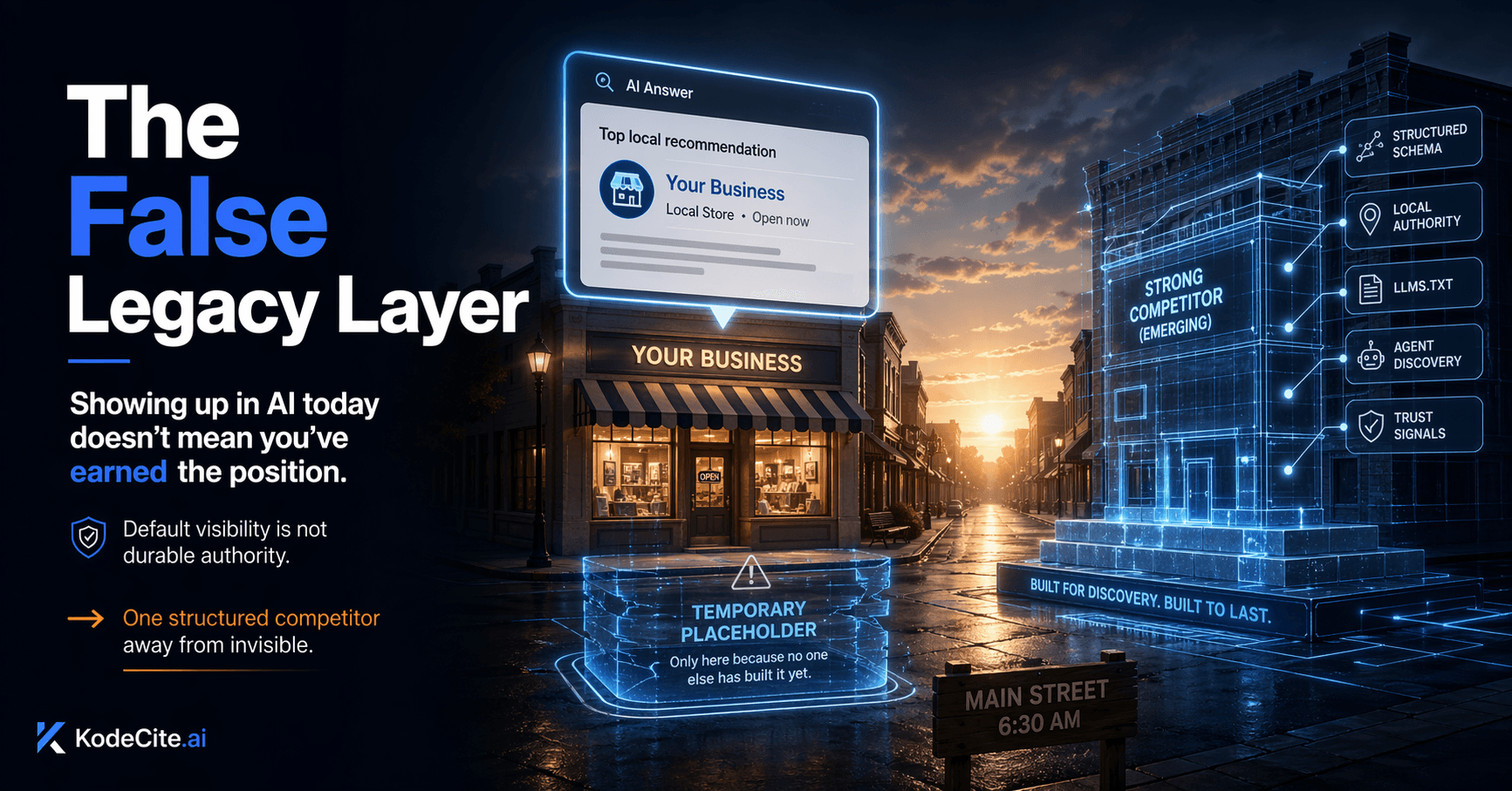
This is what we call the False Legacy Layer: a temporary, fragile position in AI answers that exists not because of what you built, but because of what your competitors haven't built yet.
It is the most dangerous kind of visibility — because it creates the feeling of safety at exactly the moment when action matters most.
What the False Legacy Layer Actually Means for Your Business
Why AI Cites You Even When Your Site Is Not Optimized
Think about it this way. Imagine you are the only store open on Main Street at 7 a.m. Every customer who walks by comes to you — not because you are the best option, but because you are the only option. The moment the rest of the street opens for business, your automatic advantage disappears.
That is the False Legacy Layer in a nutshell.
AI systems like ChatGPT, Perplexity, and Google's AI Overviews are constantly pulling from whatever sources are available, structured, and credible enough to cite. In most local markets right now, the bar is low. There is no deep schema. No llms.txt telling AI agents what the business does and who it serves. No agent.json for autonomous discovery. No machine-readable authority signals. Just a basic website — maybe a few Google reviews and a GMB listing — and the AI makes do with what it has.
Default Position Is Not the Same as Earned Authority
Earned authority is built on structured data, verified facts, consistent trust signals, and content that tells AI systems exactly who you are, what you know, and why you are the most credible source in your category and geography. Default position is what happens when the AI grabs what's available because nothing better exists yet.
The difference matters enormously — because earned authority compounds over time while default position evaporates the moment a better-structured competitor enters the space.
Being cited in AI today because no one else has shown up is not a position. It's a placeholder. And placeholders get replaced.
The Huge Leverage Window That Still Exists Right Now
Early 2026: Most Local Digital Real Estate Is Still Unclaimed
Here is the flip side of everything above — and this is genuinely good news if you are reading this before the rush.
The same emptiness that creates the False Legacy Layer also creates one of the biggest leverage windows in local marketing in decades. Because the digital real estate in most local markets is still largely unclaimed, the businesses that move quickly to structure their presence correctly can lock in the "source of truth" position before real competition arrives.
Structured schema. Hyper-local, authentic content. llms.txt as a digital ID card for AI agents. agent.json for autonomous discovery. A site that loads fast enough that AI crawlers do not abandon it before reading it. These are the signals that convert a temporary citation into a permanent position — and right now, the cost of claiming that position is as low as it will ever be.
How Early Action Compounds Into Market Dominance
Think about what happens when you invest early in a compounding asset. The returns feel modest at first. But each month, the returns build on top of the previous returns. By month 12, you are not just 12 months ahead of someone who started late — you are sitting on a position that is exponentially harder to close because the growth has been compounding the entire time.
AI visibility works identically. Early citations build trust signals. Trust signals earn more citations. More citations increase the likelihood of being the default recommended source. That default position drives higher-intent leads. Those leads convert at higher rates. And all of it reinforces the original authority signals that started the cycle.
The businesses that start now get 12 to 18 months of compounding before most competitors even begin. That gap is not 12 to 18 months — it is years of lead conversion advantage.
The Silent Vulnerability Most Business Owners Never See Coming
How Quickly the AI Can Shift Its Allegiance
Here is what makes the False Legacy Layer so dangerous: the shift away from it does not look like a drop in rankings. There is no algorithm update announcement. No warning email. No traffic report that flags a dramatic decline.
What happens instead is quieter. A structured competitor enters your market. Maybe it is an independent operator who finally invested in proper AI visibility. Maybe it is a PE-backed company that deployed a standardized optimization playbook across 40 locations. Maybe it is a regional agency that figured out what "machine-readable" actually means.
The AI model does what it always does — it finds the most credible, structured, fidelity-rich source for the query and cites that. Overnight, your business is no longer the answer. It is not even in the conversation.
THE SILENT SHIFT
No warning. No dashboard alert. No traffic spike.
The AI simply finds a better-structured source and cites that instead. Many business owners don't notice until the AI-referred calls stopped coming months ago.
You Are One Structured Competitor Away From Invisible
That is the hard truth of the False Legacy Layer: if your current AI citations are built on default position rather than earned authority, you are one well-structured competitor away from losing them entirely.
And because the shift happens at the model level — not in a dashboard you check every week — many business owners will not even notice the change until they look up one day and realize the AI-referred calls stopped coming months ago.
A temporary citation built on absence of competition is not an asset. It is a countdown clock. The question is whether you convert it into real authority before it runs out.
Private Equity, Roll-Ups, and the Threat You Can Actually Beat
How PE Firms Will Move on AI Visibility — And When
Private equity firms have been consolidating local service businesses for years. HVAC, plumbing, roofing, pest control, window treatments, property management — these categories are being rolled up into regional and national platforms backed by significant capital and centralized operations teams.
When these firms turn their attention to AI visibility — and they will, because AI-referred leads are measurably higher quality and higher value — they will not approach it the way an individual owner does. They will standardize the playbook and deploy it across every location simultaneously. Schema at scale. llms.txt across hundreds of sites. Agent discovery signals pushed from a centralized team.
When that happens, the False Legacy Layer that many independents currently rely on will not fade gradually. It will be replaced.
The One Thing PE Money Cannot Standardize: Authentic Local Depth
But here is what gives independent local businesses a genuine, defensible advantage — if they act before the rush.
PE firms can deploy technology. They cannot deploy 15 years of lived experience in a specific market. They cannot generate authentic content about the seasonal quirks of Post Falls winters, the specific drainage challenges of Hayden Lake properties, or the insulation realities of older homes in the North Idaho climate. They cannot manufacture the trust that comes from being a neighbor, not a corporation.
AI systems increasingly reward that specificity. A business that has structured its authentic local expertise into machine-readable authority signals — with genuine depth, real reviews from real neighbors, and hyper-local content that a corporate template could never replicate — can hold a position that corporate dollars struggle to dislodge.
There is one more layer worth noting: if a PE firm ever does approach your business about acquisition, being the dominant AI-cited authority in your local market significantly increases your valuation. You are not just a service business — you are a business with an established, compounding digital presence the acquirer inherits on day one.
Why Acting Now Creates Permanent Advantage — And Why Waiting Creates the Opposite
The Land Rush Is Happening Whether You Participate or Not
Think of digital real estate the way you think about physical real estate. Fifty years ago, ocean-front property on the West Coast was affordable and largely unclaimed. The people who bought early did not just get cheaper land — they got decades of compounding appreciation that latecomers could never access at the same entry price.
That same dynamic is playing out in AI visibility right now. The digital territory in your category and your market is still largely open. The cost of claiming it — in time, in investment, in competitive effort — is as low as it will ever be. Every month that passes is a month that another business could be filling that space.
Late Movers Are Not Just Behind — They're Starting a Different Race
The businesses that start in 12 to 18 months are not just 12 to 18 months behind the early movers. They are attempting to displace businesses that have been compounding citations, trust signals, and AI-referred leads for over a year. Dislodging an entrenched AI authority position requires significantly more effort, more content, more investment, and more time than establishing one in the first place.
Late movers are not starting the same race from a different position. They are starting a harder race entirely.
The window is open in 2026. It is not open indefinitely.
The Window Is Still Open — But the Clock Is Running
Your Local Knowledge Is the Raw Material AI Is Learning to Reward
Your local expertise, your community reputation, your years of solving problems in a specific geography for real people — that is exactly what AI systems are becoming better at identifying and rewarding. You already have the raw material.
The question is whether you turn it into a permanent, structured, machine-readable advantage before someone else claims that territory.
If you are currently showing up in AI answers, that is a starting point — not a finish line. The False Legacy Layer is real, and the businesses that treat today's citations as earned authority rather than borrowed time will be the ones caught flat-footed when the space fills up.
The businesses that treat today's citations as the beginning of a compounding investment — and act accordingly — will be the ones that still own the answer space two years from now.
KodeCite.ai helps independent local and regional businesses build structured AI visibility through high-performance sites, machine-readable authority layers, and Answer Engine Optimization strategies that turn local expertise into permanent AI dominance.
Get your free AEO Audit at KodeCite.ai. Find out how close you are to losing — or locking in — your position.